

Chapter 04 of 12
LANDING ZONE
Network and ingress
Network inside the accounts
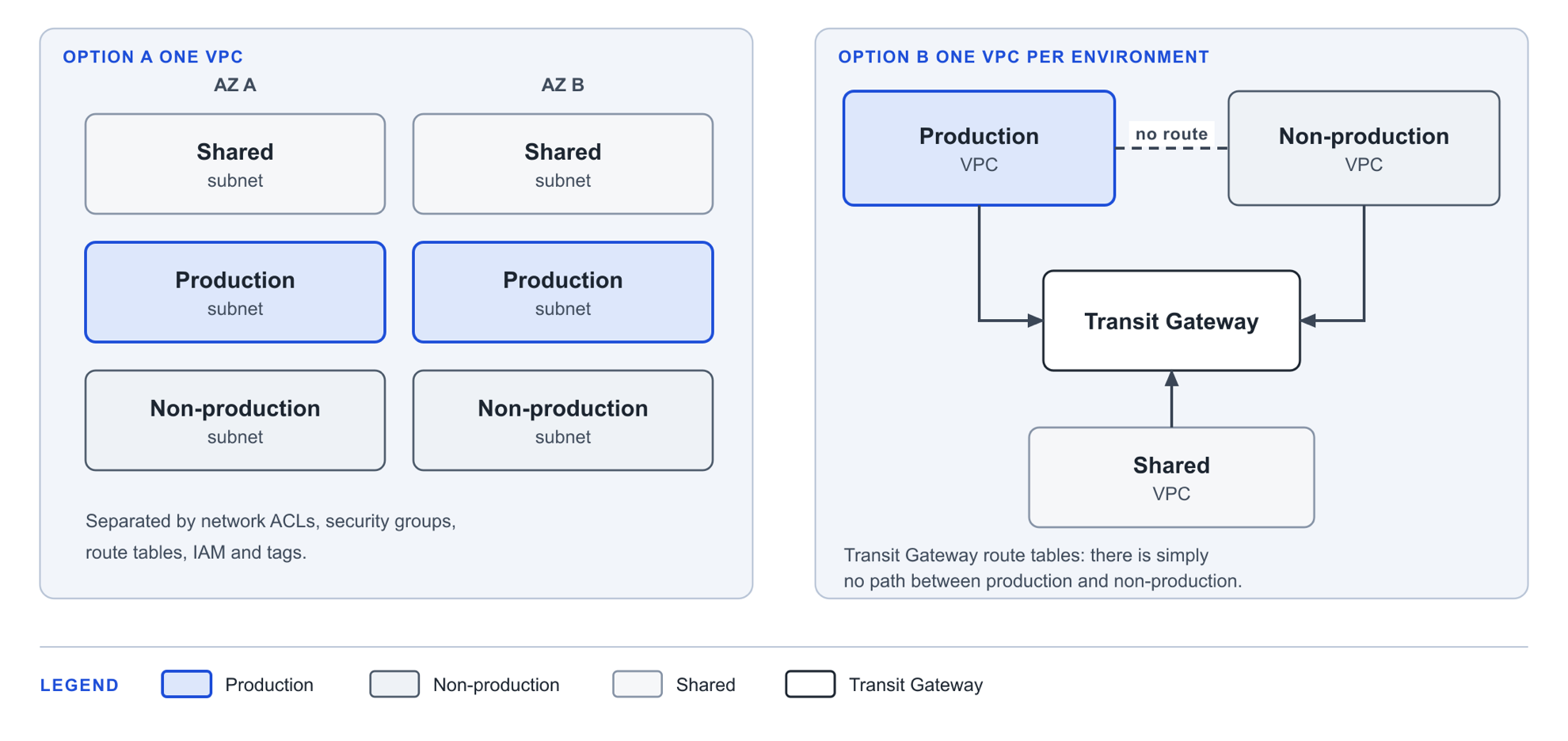
There are two common layouts. Both keep production and non-production apart. They differ in where the boundary sits.
| Option A: one VPC | Option B: one VPC per environment | |
|---|---|---|
| Shape | Production and non-prod in separate subnets of the same VPC | Production, non-prod and shared each get their own VPC, joined by a Transit Gateway |
| What separates them | Network ACLs, security groups, separate route tables, IAM and tags | Transit Gateway route tables: there is simply no route between prod and non-prod |
| Strength | Lowest running cost, simplest to start | A security group mistake cannot open a path between environments |
| Cost | No Transit Gateway | Transit Gateway attachments and data processing |
Plan IP ranges early. If AWS will ever connect to your existing networks or your offices, the AWS ranges must not overlap with them.
How traffic gets in
| Pattern | How it works | Good when |
|---|---|---|
| Single account | One VPC with its own Internet Gateway and load balancer | One team, one workload, moving fast |
| Decentralized ingress | Every workload account has its own Internet Gateway and its own ALB | A few accounts, each team runs its own front door |
| Centralized ingress | Only a network hub account has an Internet Gateway. Its ALB reaches each workload through AWS PrivateLink to a Network Load Balancer in the workload account | Many accounts, one team owns the WAF and inspection |
In the centralized pattern the Network Load Balancer sits in the workload account because a PrivateLink endpoint service has to be fronted by a Network Load Balancer.